Williamson County New Construction: What Sellers Compete With
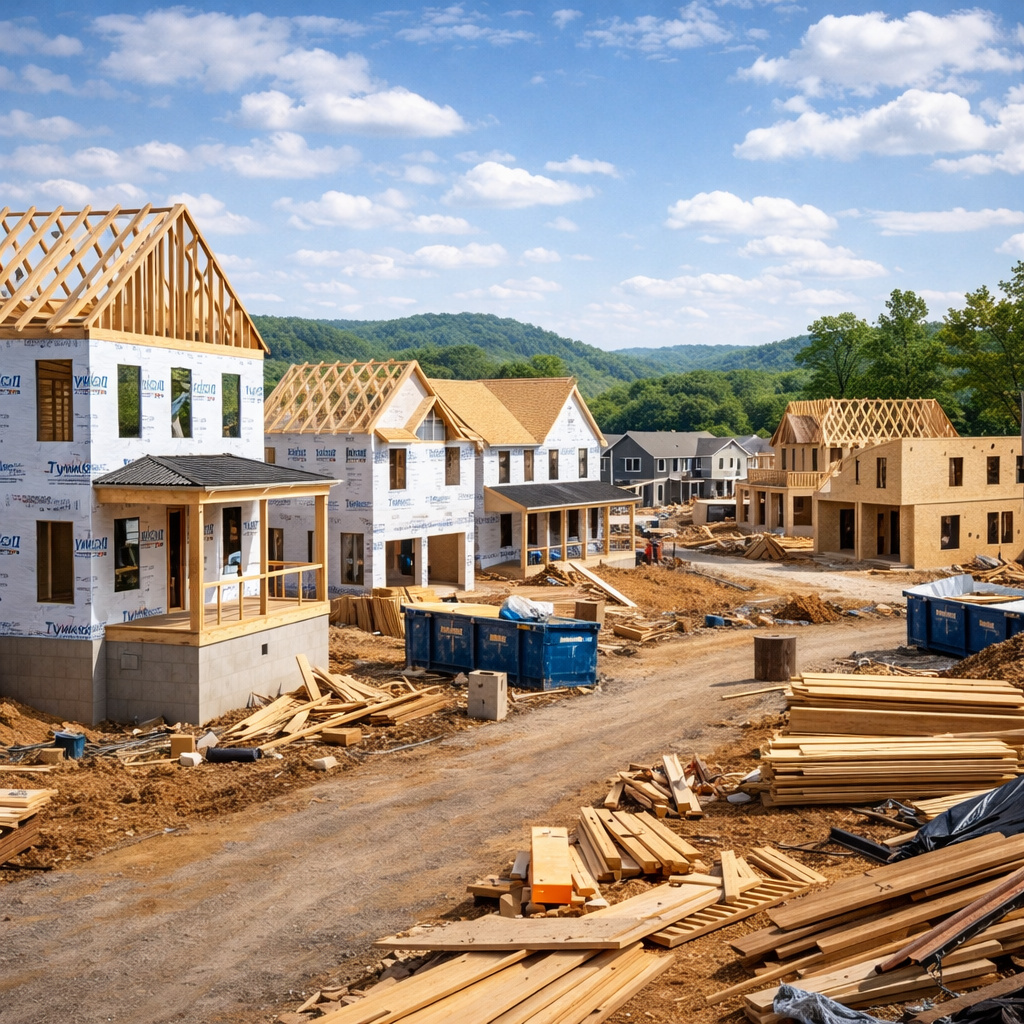
Who You’re Competing With in Williamson County
Across the twelve months ending September 2026, new construction accounted for 24% of Williamson County closings at $500,000 and above. For a seller, that means roughly one in four buyers who could have chosen a resale chose a builder instead. Where the property sits determines whether that share is closer to one in six or closer to three in five.
The comparison most sellers never run
Most sellers prepare for the wrong competition.
The instinct is to look at the three or four properties nearby that are listed at a similar number — the same street, same subdivision, roughly the same square footage — and to price against those. It’s a reasonable instinct. Those properties are visible, they’re easy to find, and a buyer’s agent will pull exactly that list.
But a buyer standing in a property and deciding whether to write isn’t only comparing it to other resales. They’re comparing it to everything their money reaches, and in this county a meaningful share of what their money reaches hasn’t been lived in yet.
The question people ask isn’t what their property is worth. It’s who they’re competing against for the buyer who can afford it.
The number
Across the twelve months ending September 2026, new construction made up 24% of Williamson County closings at $500,000 and above — 1,055 sales out of 4,363.
That figure counts properties recorded as newly built, built to contract, or builder models. It doesn’t count renovated properties, which are a separate category and are counted as resales here.
Framed as context rather than proof: roughly a quarter of the closings in this county over the last year were transactions where a buyer chose a property that nobody had lived in. That’s not a fringe of the market. It’s a quarter of it.
Where that quarter is concentrated
The county figure is an average, and averages hide the thing a seller most needs to know. The same twelve months, broken out by municipality:
Market New construction share of closings, $500K+
Fairview 59.8%
College Grove 45.6%
Arrington 38.9%
Spring Hill 36.2%
Thompson’s Station 33.6%
Franklin 17.2%
Nolensville 17.0%
Brentwood 15.0%
Same source, same twelve months, same definition. The county figure of 24% is this table averaged and weighted by volume — not a separate measurement.
Two markets are doing something entirely different from the other six. In Fairview, more closings above $500,000 went to new construction than didn’t. In College Grove it’s close to half. A seller in either place is competing primarily with builders, and the properties they’d naturally price against are the minority of what buyers are actually choosing.
At the other end, Brentwood and Franklin sit at roughly one in six. A seller there is mostly competing with other resales, which is the assumption almost every seller starts with — and in those two markets, the assumption holds.
Thompson’s Station, Spring Hill and Arrington sit between the two poles, at roughly a third. That’s the range where the assumption is most likely to be wrong without being obviously wrong.
What it means for a decision
New construction competes on a specific and narrow thing: nothing needs doing.
A buyer choosing a build is buying finishes they picked, systems under warranty, and the absence of a weekend spent deciding whether the cabinets can wait another year. They’re paying for that, and often paying more per square foot for less land and a shorter tree line. What they’re not doing is absorbing a project.
A resale property competes on things a builder can’t sell: an established neighborhood, mature landscaping, a lot that isn’t a rectangle, a location that was chosen before the road went in. Those are real advantages and they hold their value in a way finishes don’t.
The difference between competing well and competing badly comes down to whether the property’s condition lets a buyer see those advantages, or asks them to look past a list of things to do first. A property with genuine location and land advantages and a dated interior is asking a buyer to run a comparison that a builder has removed from the table entirely.
That’s the practical weight of the number. It isn’t that new construction is better. It’s that in some parts of this county, “nothing needs doing” is what a large share of the buyer pool has already decided to pay for — and a seller who prepares for the wrong comparison finds that out through silence rather than through feedback.
What the number doesn’t say
It doesn’t say resale can’t win. Most of the market is still resale, including in the markets where new construction is heaviest.
It doesn’t say a seller should renovate. Some properties earn back preparation and some don’t, and that turns on the specific gap between the property and what buyers in that price band have been choosing — not on a county average.
And it doesn’t say a seller in Brentwood should worry about the same things as a seller in Fairview. A four-times difference in the local share is the whole point of the table.
One durable observation, though, worth carrying beyond this year’s figure: the share doesn’t fall as you move up the price ladder. It rises. The intuition that new construction is an entry-level story doesn’t hold in this county, and a seller at the top of the market is competing with builders more, not less.
The decision recap
If a property’s strongest arguments are its location, its land and its neighborhood, and the interior lets a buyer see them, competing against new construction is a fair fight and often a winning one.
If the strongest arguments are location and land but the interior asks a buyer to take on a project, then the comparison is being run against a product built specifically to eliminate that project — and the price has to answer for it, or the condition does.
Common questions
How much of the Williamson County market is new construction?
Across the twelve months ending September 2026, new construction accounted for 24% of closings at $500,000 and above in Williamson County. The figure counts newly built, built-to-contract and builder model sales, and treats renovated properties as resales.
Does new construction compete with a resale property?
It does, though not on the same terms. New construction competes on the absence of work — chosen finishes, warrantied systems, nothing deferred. A resale competes on established location, mature landscaping and lot characteristics a new subdivision can’t reproduce. Whichever a buyer weights more heavily decides the comparison.
Is new construction more of a factor in some Williamson County markets than others?
Over the same twelve months, the share ranged from rouZhly 15% in Brentwood and 17% in Franklin to 45.6% in College Grove and 59.8% in Fairview. A seller’s competitive picture depends far more on the local figure than on the county average.
Does the new-construction share change at higher price points?
It rises rather than falls. New construction is often assumed to be a first-time-buyer story, and in Williamson County that assumption doesn’t hold — the share of closings going to new construction is higher above $1M than it is across the market as a whole.
Should a property be updated before selling if the competition is new construction?
It depends on the size of the gap and on what the local buyer pool has been choosing, not on a county-wide figure. The question worth answering first is whether the property’s location and land advantages are visible to a buyer standing in it, or whether they’re obscured by work the buyer would have to plan around.
The figures above come from RealTracs closed-sale data for Williamson County, residential, $500,000 and above, for the twelve months ending September 2026. New construction is defined as sales recorded as new, to-be-built or builder model.